


In yesterday’s posts I left you with a small riddle, asking whether anyone would recognize the building were I shot the abstract fine-art architectural shots. While no-one came up with the right solution (Oculus – World Trade Center Station in New York City), a few readers correctly recognized the work of architect Santiago Calatrava. Today, continuing my series “NYC Experience” from our trip to the Big Apple in 2018, I show you a bit more of the outside and interior of this new iconic NCY landmark.


After the terrorist attacks on the World Trade Center in the fall of 2001, the New York subway could no longer operate to the World Trade Center because the station had been destroyed. After the cleanup at Ground Zero, which officially ended in May 2002, the rail facilities were restored and a new entrance was provisionally built by the New York Port Authority, which was able to begin operations in November 2003. Since the complex was also scheduled for reconstruction, the rail station retained its previous name. After the final design of the new World Trade Center complex was finalized in 2006, new facilities for public transportation were also designed, called the World Trade Center Transportation Hub. They were designed by famous Spanish architect Santiago Calatrava. Above ground, the new station is to consist of a large glass structure that will be flooded with light.


Construction of the Transportation Hub began in 2008, and the partial opening of a first platform took place in February 2014. On March 3, 2016, the station’s main concourse, called Oculus, was opened to the public. It provides access to Port Authority Trans-Hudson (PATH) commuter trains to New Jersey and eleven NYC subway lines.
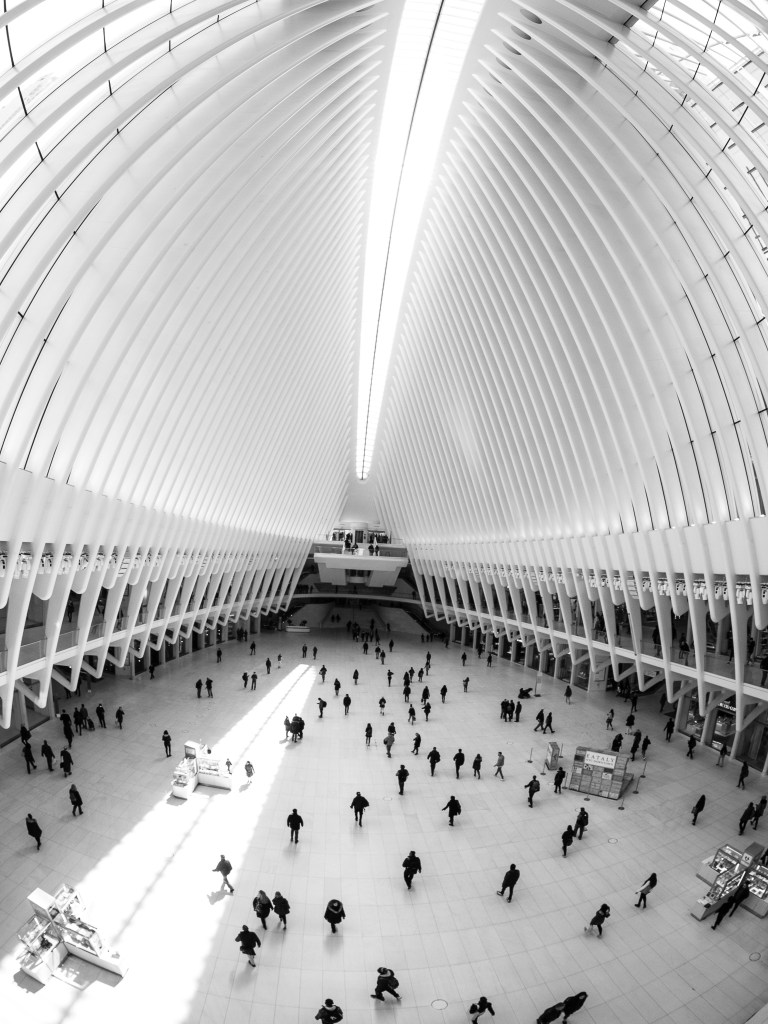
The design by Calatrava symbolizes a dove taking flight. The structure is formed by softly-curving, white steel ribs, that rise from below the ground to form an elliptical dome over a vast concourse. The Oculus uses 11,500 tons of steel, and free from internal supporting columns, the concourse reaches a length of 350 ft and a height of 160 ft.
The transparency of the structure and a skylight, that runs the length of the Oculus’ spine, allows light to flood through onto the grey and white marble floors below.


If you want to read more about this fascinating building, check its entry in wikiarquitectura.
I hope you liked this episode NYC Experience – Oculus. Even though the trip (and most other of the episodes) happened back in the travel happy times of 2018. Below are a few links to other episodes, or you just enter “NYC Experience” in the search field of the blog to see them all.
The photos were taken with my Olympus OM-D E-M1 and the mZuiko 12-100mm F/4 and the WALIMEX Pro 7,5mm 1:3.5 Fish-Eye. RAW conversion and post processing in Lightroom Classic.
Wish you all a great Monday!
Marcus
Related Posts: