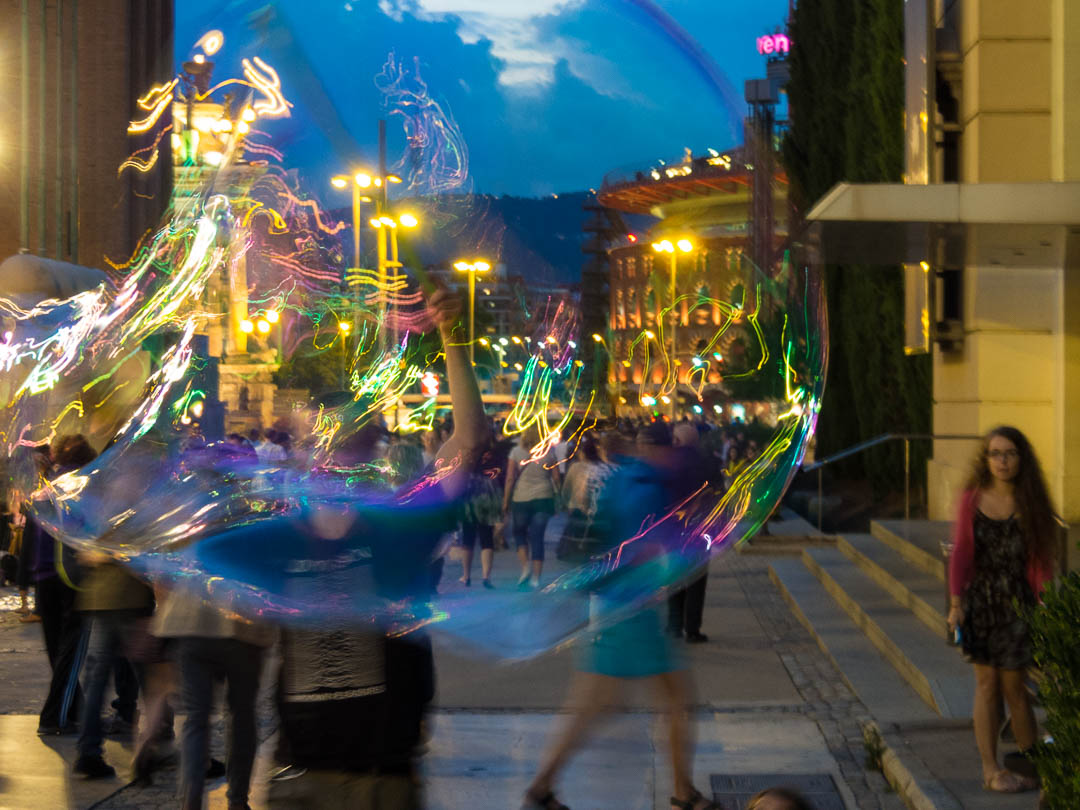
“Instant Inspirations” is my series for you if you feel you suffer from “Photographer’s Block” or simply want to shoot something that you have never tried. Or at least not recently. Episode 12 should inspire you to go out and capture “playfulness”. For more exemplary photos, some advice and the links to all previous episodes continue reading after the jump…
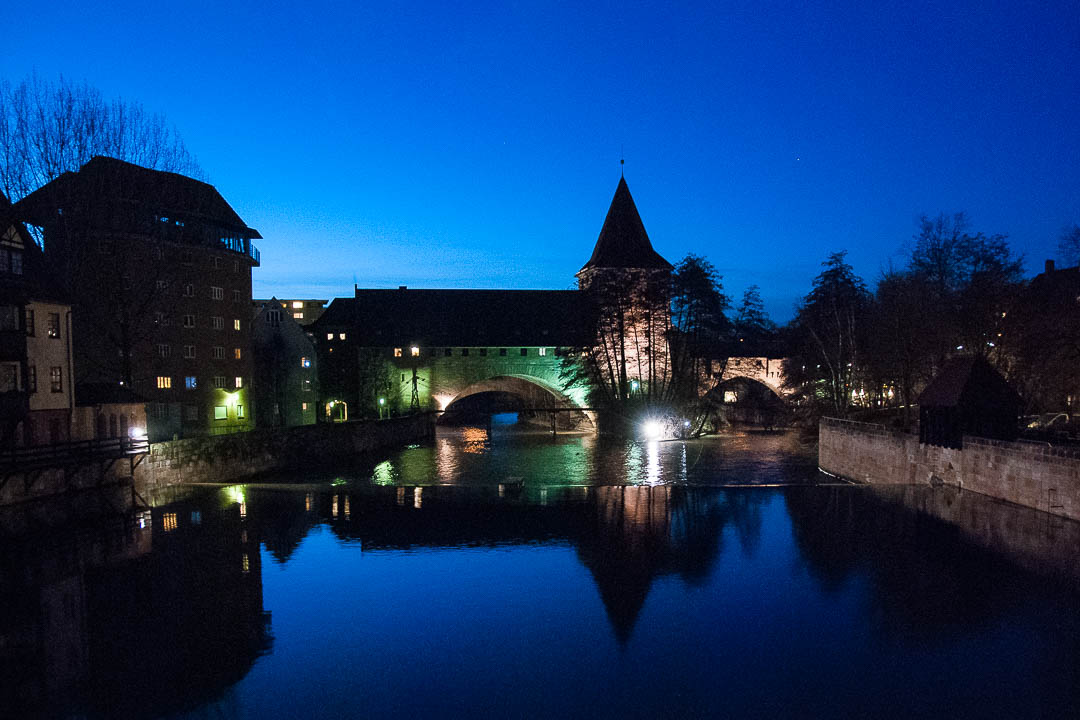
One from the archives – Blue Hour on the Pegnitz River. Visible in the Background is the Hallertorbrücke, the Western exit of the Pegnitz from Nuremberg’s Old Town. The bridge house made out of sand stone was built in 1697 in place of the original wooden bridge constructed 1564.
The photo was taken with 1/3 sec at f/4 and ISO 800. Camera was on a tripod. I forgot to dial the ISO down (what is the sense of having the cam on a tripod and not shooting on lowest native ISO). But somehow I like the noise in the image, so I kept it. It is so much fun to shoot during the blue hour, you should try it!.
Tomorrow is once more a travel day, I’m heading to Detroit for a day and a half of meetings, will be back in Nuremberg Saturday.
The weekend is finally here, and with it a new episode of my “Instant Inspirations”. If you feel you suffer from “Photographer’s Block” or simply want to shoot something that you have never tried or at least not recently, then this series is for you. My inspiration for you in episode 11 is to try a change of perspective. In my very first episode of “Instant Inspirations” I talked about “getting down low”. Today’s post is about looking down, looking up and looking outside in. To see my other change of perspective photographs continue reading after the jump….
I recently have discovered the Weekly Photo Challenges on WordPress for me. It is so much fun to try to answer these challenges with Street Photography images. This week’s theme of Cee’s Black & White Photo Challenge is “Music”.
Frequent readers probably have already seen my four entries for the “monochrome music” challenge.
To see all my other monochrome music photographs for Cee’s challenge and for the links to the original posts continue reading after the jump….
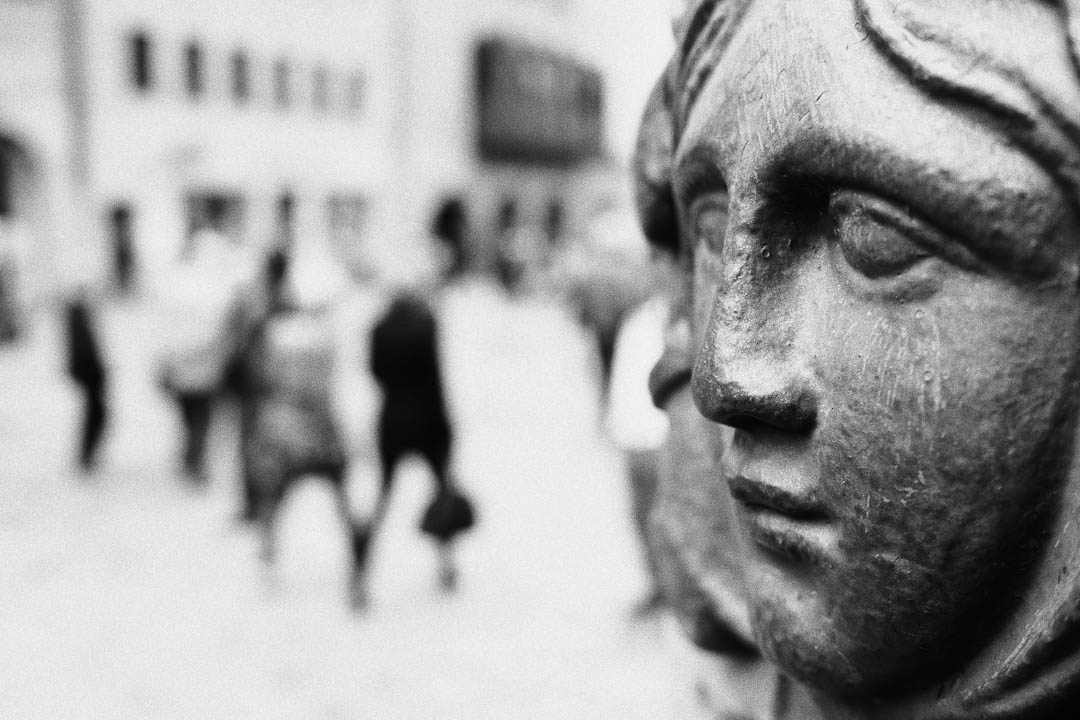
Detail of a bronzen face on Nuremberg’s Fountain of Virtue (Tugendbrunnen) created by Bendikt Wurzelbauer in the years 1584-1589, situated next to the North Tower of St. Lorenz Church.
It was a conscious try at a high key photo with a very narrow depth of field to fully blur out the passing shoppers. I dialed in 2/3 of a stop positive exposure compensation. Image taken with the Olympus PEN-F with the mZuiko 17mm f/1.8 prime lens at 1/250 sec, f/3.5 and ISO 200. There is this rumor that mirrorless cameras can’t create a decent bokeh…
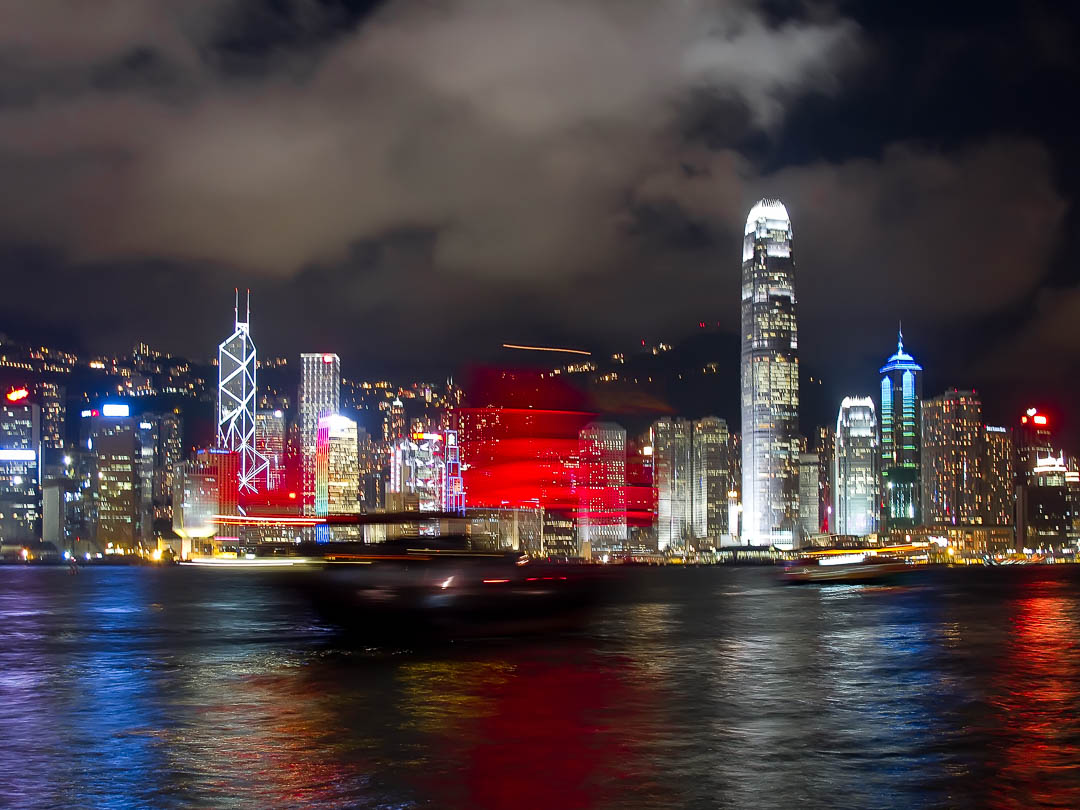
Hide and Seek | Hong Kong | 2 sec @ f/3.5 and ISO 100
The perfect way to start into February is with Episode 10 of my Instant Inspirations (links to previous editions at the end of this post). Today I talk a bit about photographing nocturnal skylines and want to provide you with some inspirations to give your skyline photography some fresh angles, which of course would be also valid for shooting skylines during the day. To find out more about how you can bring some new life into your city skylines continue reading after the jump….
A year ago today I started my photography blog “Streets of Nuremberg” with the post Shooting on a rainy Saturday. Completely new to blogging I had no idea what I got myself into and where this would lead me. My idea was to use it as sort of my own photographic diary as well as my space on the web where I could share with others my experiences on my way deeper into photography and some tips and inspirations for others to try.
The Journey was amazing! I would have never expected what this blog has developed into. First of all, and most important of all, I would like to extend a big, huge, gigantic and heartfelt “THANK YOU” to all my readers, followers and supporters!
For a few insights into this amazing ride, some reflections and outlook to what’s to come continue reading after the jump….
After lots of photography related posts it is about time I show you some more of my hometown Nuremberg. In this latest episode of my series “Nuremberg Explored” I take you back some 180 years to the very beginnings of railway industry. For the whole story and more photos of the historic steam train continue reading after the jump….
Saturday afternoon was the annual concert of the Lutheran Trombone Choir Feucht (Evangelischer Posaunenchor Feucht) in St. Sebald, one of the two main churches in Nuremberg’s Old Town. If you want to find out why this is so special for me that it deserves an “off topic” blog post, to see more photos and even a video of one of the Christmas Chorals played continue reading after the jump…
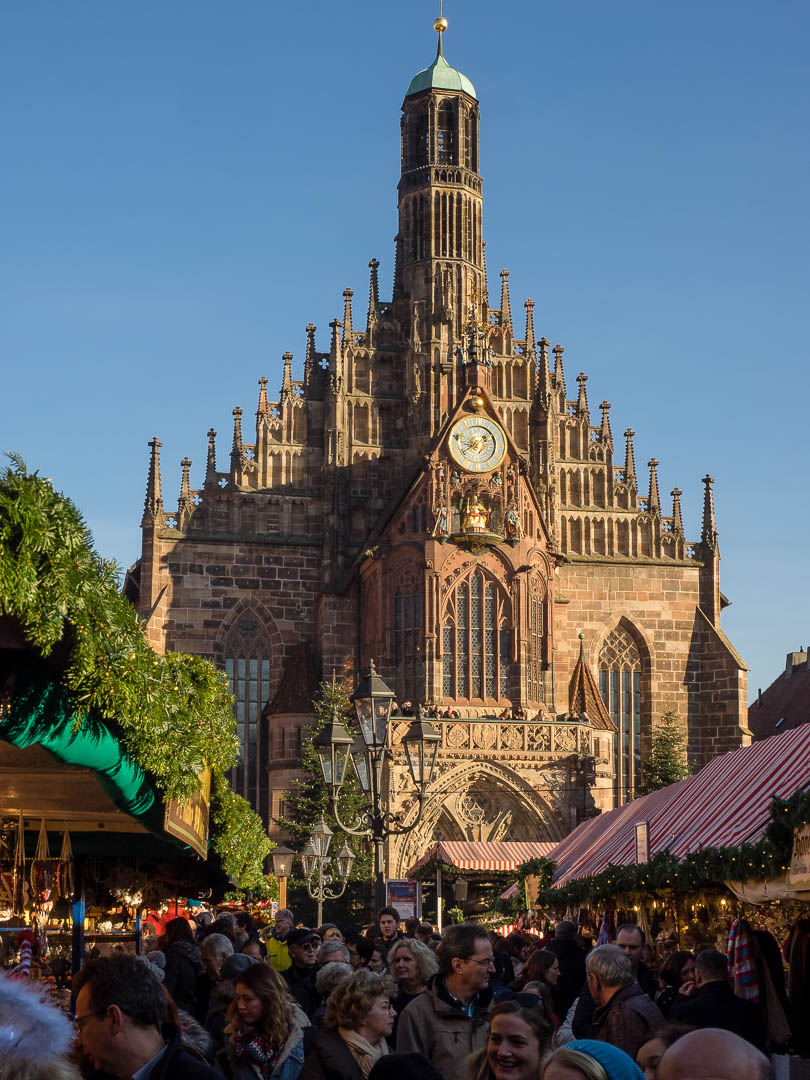
While today it is pouring down once more, yesterday was a glorious December Saturday. Although we are far from having any snow (and the temperatures felt more like spring) it was still a special atmosphere on Nuremberg’s famous Christmas Market, the “Christkindlesmarkt” as it is called locally. It takes place in the four weeks leading up to Christmas (Adventszeit) on the main Market Square in front of the famous Frauenkirche (built in the 14th century). For more impressions continue reading after the jump…..
Hangman’s Residence | Nuremberg | 2016Today’s episode of Nuremberg Explored features the Henkerhaus (Hangman’s House), built together with the adjacent Henkerturm in the early 14th century as part of Nuremberg’s medieval city fortifications.
Situated in a sandstone bridge directly over the Pegnitz river the Henkerhaus is the former official living quarters of the executioner of the free imperial city of Nuremberg. The historic building houses a museum that offers fascinating views into the job and the criminal history in medieval Nuremberg. Much of the information comes from first hand, as Franz Schmidt, the most famous of the city’s hangman’s provided insights into his life by leaving us his diaries. Nurembergs Hangman’s lived their isolated lives in these quarters for almost 400 years from the 15th century to 1806.
The buildings on the left are the Wasserturm (Watertower), built in 1320-1325 and the Weinstadel (Winehouse), a historic half timbered house that today is used as a student dormitory.
I took the photograph with my Ricoh GR II with 1/6 sec, f/2.8 and ISO 1600. B&W conversion in Lightroom CC.
The Weißgerbegasse is a scenic alley in Nurembergs historic old town north of the Pegnitz River. Since medieval times home to the profession of the tanners (hence the name, tanner or skinner =Gerber), the ensemble of 20 half timbered houses (Fachwerkhäuser) has survived the bombings of WW II, has been lovingly restored and is now part of Nuremberg’s Historic Mile (will do a separate future post about that). Continue reading “Nuremberg Explored (2)”→






Recent Comments