


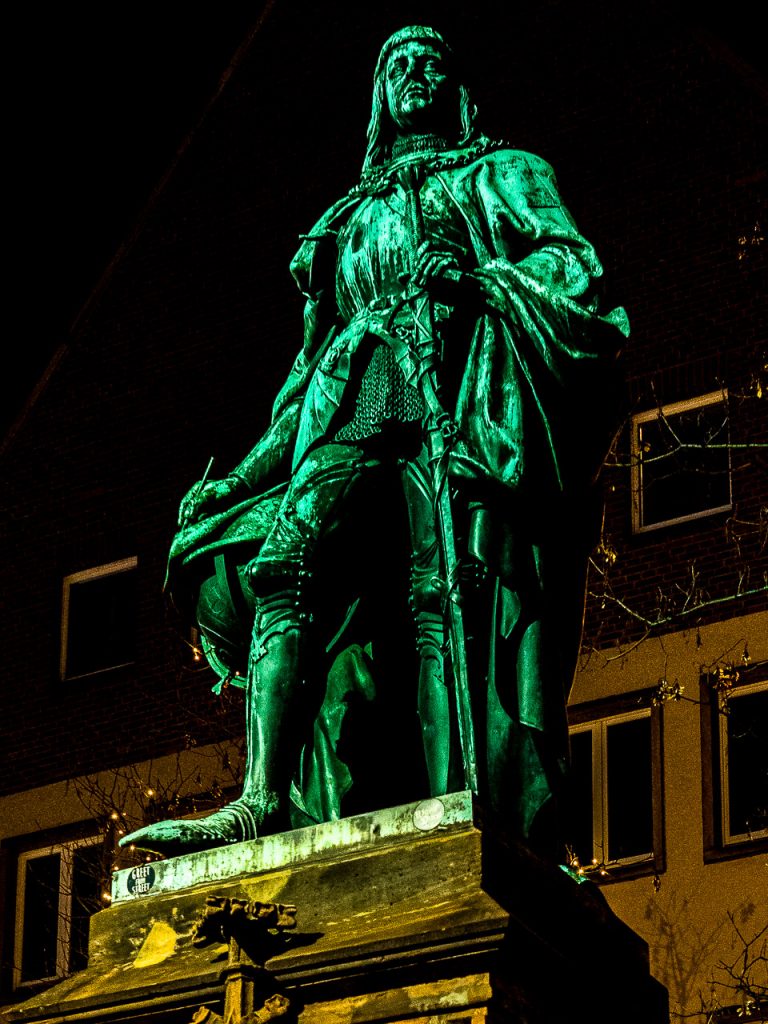
It’s been a while since my last episode of “Nuremberg Explored”. But when tonight The Significant Other, myself and good friends went for dinner in a restaurant at Theresienplatz in Nuremberg’s Old Town, I took some pictures of the monument of Martin Behaim, and coming home, I thought I share his story with you.
Martin Behaim, born in Nuremberg on 6 October 1459 as a son of a city senator, was a textile merchant and cartographer. During his voyages he also came to Lisbon, were he served King Joao II of Portugal as an adviser in matters of navigation. He also participated as navigator in a Portuguese explorer voyage to West Africa in 1585, and he became the first German to set foot on the shores of Southern Africa at Cape Cross in Namibia. But his real claim to fame is that Martin created the “Erdapfel”, the world’s oldest surviving globe, which he produced for the Imperial City of Nuremberg in 1492 (the year Columbus discovered America).

In the Middle Ages, the apple was the most common metaphor for the earth, for example in the form of the imperial orb as an insignia of the emperor.


The globe is about 51 cm (21 inches) in diameter and was made from a type of paper-mache coated with gypsum. The ball was built into a wooden tripod and secured by a pair of iron hoops. The map drawings were painted on parchment and pasted around the sphere. The globe contains more than 2,000 place names and 100 pictorial illustrations.Many of the inscripted notations deal with foreign countries and their inhabitants, plants and animals, but with trade, explorations, and hints for famous travelers like Marco Polo. During World War II, the globe was kept in the Nuremberg art bunker. Today the globe is on display in the Germanisches Nationalmuseum in Nuremberg.
Martin Behaim did not benefit from his creation, neither did he find favor with the successor of Joao II. He died on 29 July 1507, completely impoverished, in Lisbon. His son later moved back to Nuremberg.
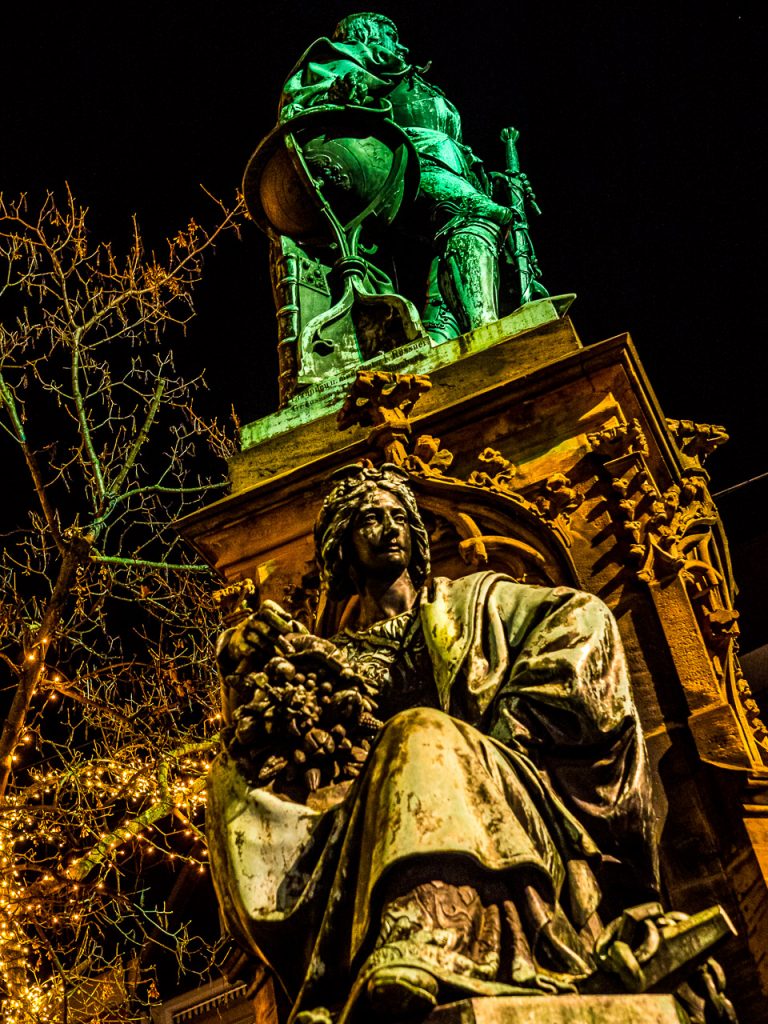
The monument on the Theresienplatz was revealed in 1890. On a neo-Gothic sandstone base stands a larger-than-life, 3 m high statue of Martin Behaim in the ornat of a medieval knight with his globe at his his side. He is flanked on the left and right by two seated persons embodying trade and science.
I hope you liked this new little excursion into Nuremberg’s history.
Wish you a great Wednesday
Marcus
Related Posts:
Nuremberg Explored (3) – Hangman’s Residence