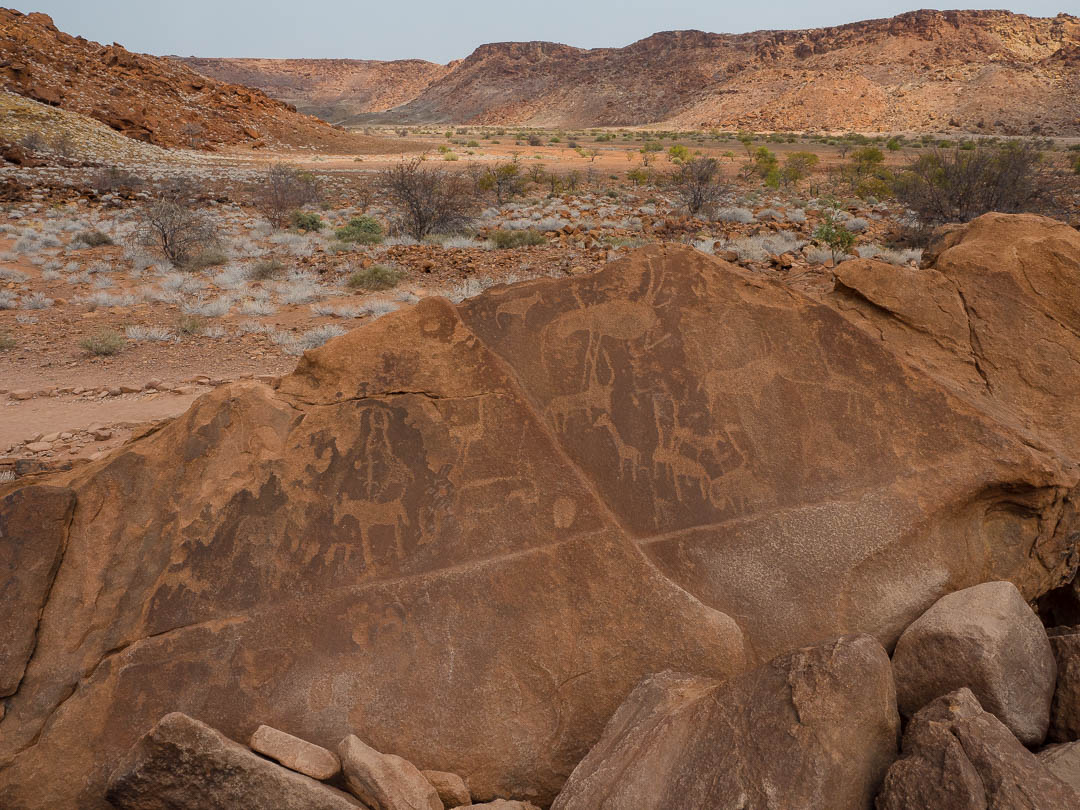
The last stop before finishing our memorable Namibia vacation in Etosha National Park was at a veritable UNESCO World Heritage Site, the world-famous stone-age rock engravings of Twyfelfontein in the Kunene region of north-western Namibia. For more photographs and info about this fascinating place, a glimpse of a petrified forest, some more roadside giraffes and another African sunset photo continue after the jump…
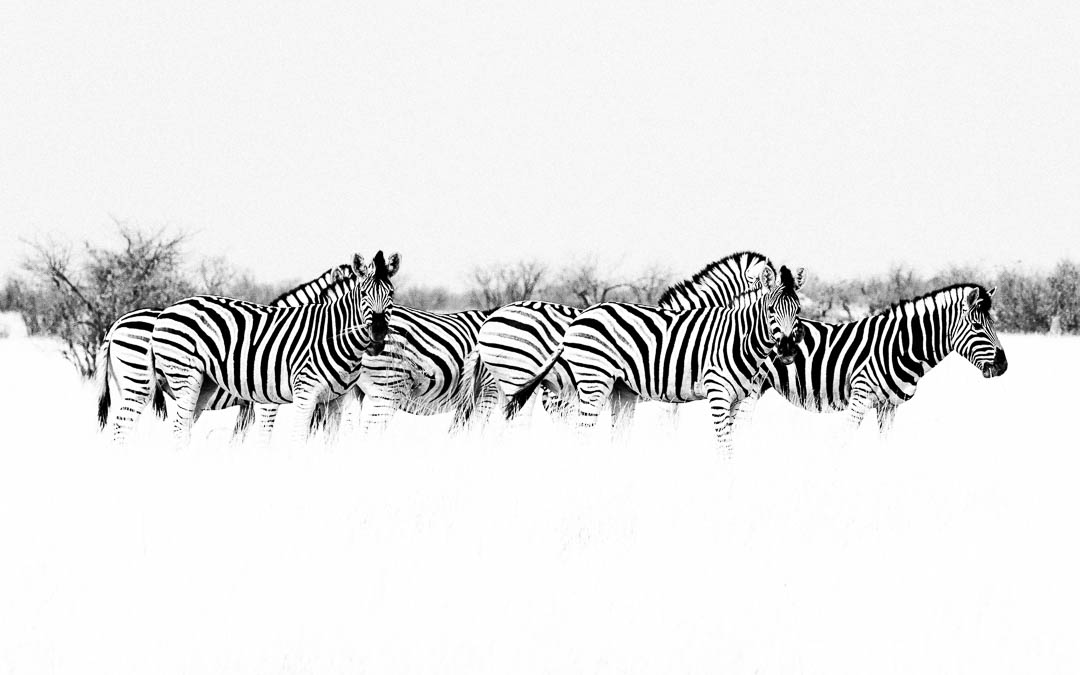
Somehow I have a hard time transitioning back to Street Photography, so here find another Africa post. While sorting through my Namibia photos and selecting the ones I want to include in the photo book of our vacation, in a calendar etc…. I was also playing around with animal images I could convert to monochrome. I have a high key preset in Lightroom that I wanted to try out on panoramic groups of animals I photographed in Etosha National Park with my Olympus OM-D E-M1 with the mZuiko 40-150mm F/2.8 with the MC-14 Tele-Converter that increases focal length by factor of 1.4 . The Lightroom adjustments basically include increasing exposure and playing with the grad curves, were I increased the light midtowns and turned down the dark midtowns, to get that high key effect. I also increased the contrast and the clarity. To see more monochrome Etosha wilderness photos continue after the jump….
A big giraffe sleeping all curled up like a dog? Are you kidding me? But look for yourself! If you want to find out if this really was a sleeping giraffe, and to read about our lonesome but fascinating hike to a cave up in the Erongo mountains were we found bushmen’s paintings and and carvings presumed to be more than five thousand years old, continue after the jump…. Continue reading “Namibia Explored – Erongo Mountains”→
After just three days in the office, Namibia seems to be a distant dream. Amazing, how fast a three week vacation can pass, when you are fully focused on making the most out of your family time while traveling through a truly magic country in Southern Africa.
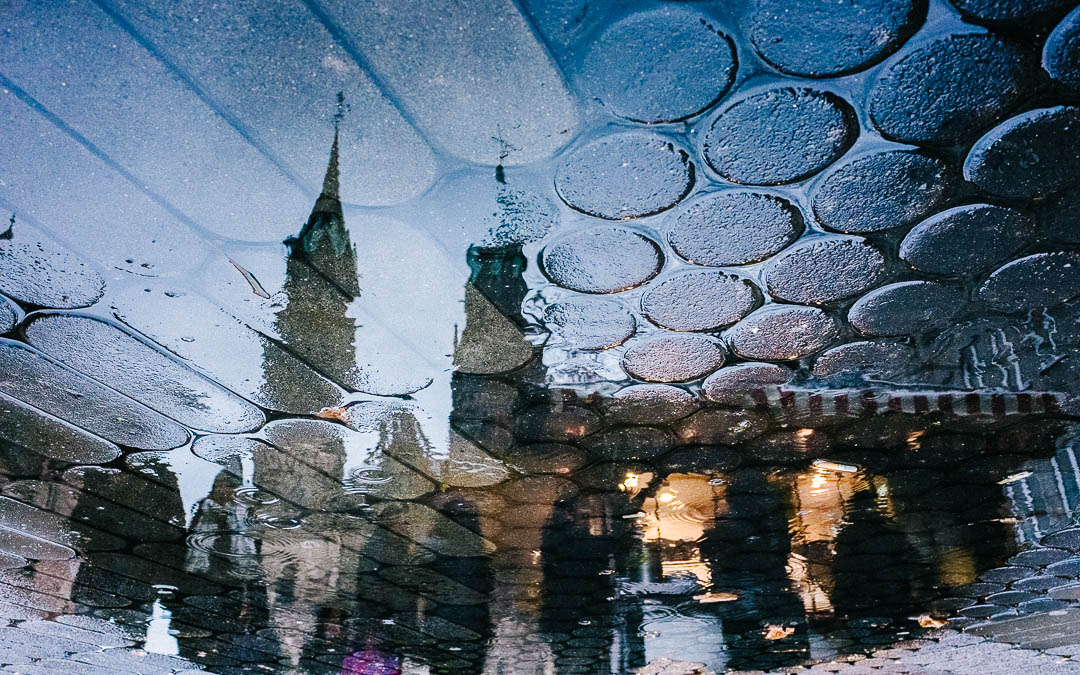
Besides being back in the treadmill of the job that pays the bills, looking out the window is truly frustrating. Photographically speaking, instead of focusing about playing with the light in the great sand dunes of the Namib Desert, or dialing in a wide aperture to throw the background behind the lion’s head properly out of focus, I know need to start thinking again about making use of puddles to capture nice reflections.
Well, know worries, there are plenty nice memories of Africa in the raw files on my MacBook’s SSD that still need sorting and working on. So you can expect a few more post as I finish up my “Namibia Explored” series in the coming days.
But outside it is cold, grey and rainy. Back on the autumn Streets of Nuremberg.
Check out my Learning Center with all my free tips and inspirations on photography, including puddle shooting 😉
If you are an internet junkie, Namibia might not be the perfect place for your vacation. We had no web connection for more than a week, since leaving Swakopmund. We are currently in Etosha National Park in the north of Namibia, almost at the end of our three week Namibia vacation. So far it was a magic trip. But with my posts about Namibia I want to stay in sequence, so today I want to show you photos of a trip to the high sand dunes of Sandwich Harbor, where the Namib desert meets the cold waters of the South Atlantic Ocean.
We booked a day trip from Swakopmund with Turnstone Tours (as always, the included links are just for your reference, because I really liked the service, and I did not receive any benefits from posting the links). With our tour guide/driver Burger (hey Burger, if you ever read this, thanks for a super great day!!) we took of at 8:30 am from Swakopmund and drove down to Walvis Bay. On the 1.400 kilometers of Namibian coast line, there are only two natural harbors, Luderitz Bay and Walvis Bay, the rest is barren coast, with no fresh water and plenty of fog, appropriately named the “Skeleton Coast”. First stop was the Walvis Bay Lagoon, where we had beautiful views of the resident Flamingo population. For all the infos and the photographs of our great dune adventure continue after the jump…. Continue reading “Namibia Explored – Sandwich Harbor”→
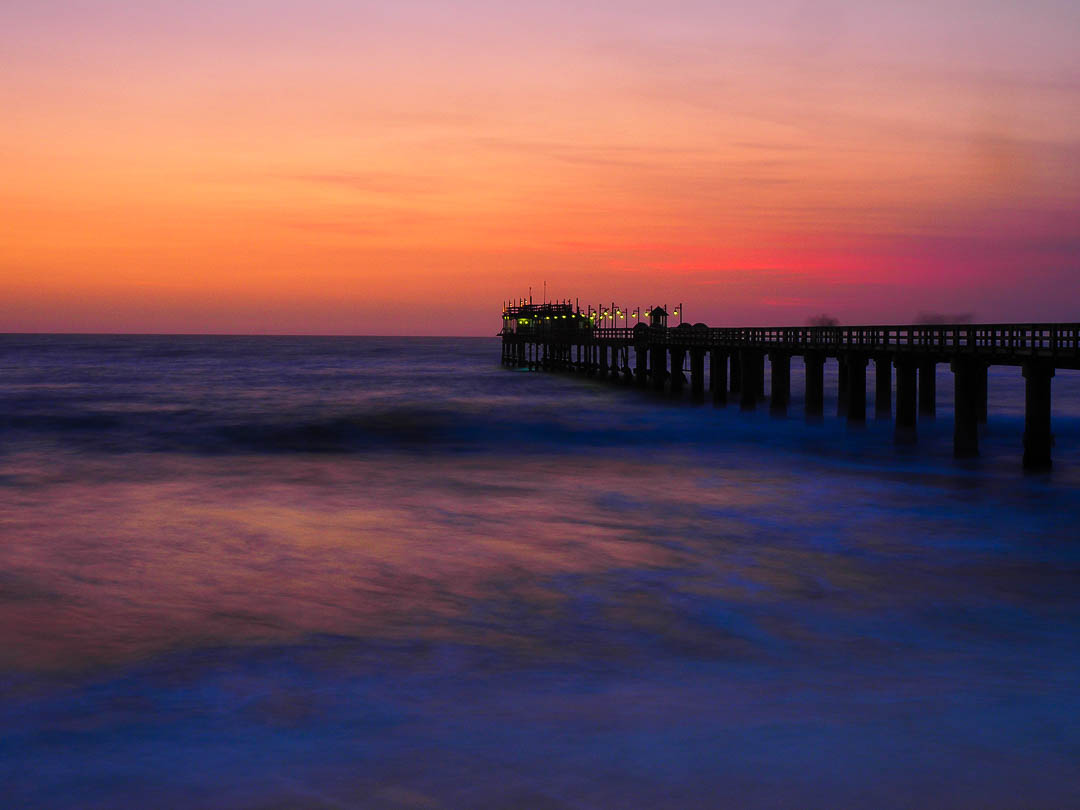
Driving on African gravel roads is tiring. The landscape around you is fantastic, bit keeping the car steady on the gravel or sandy roads takes a lot of effort, you can never drive on “autopilot”. After a 380 kilometer and 6 hour trip on unpaved roads we arrived at the coastal town of Swakopmund. After checking into our B&B we went straight to the historic jetty to experience the African sunset behind the Southern Atlantic Ocean.
Despite having a coastline of 1400 kilometers, Namibia has only two natural ports, Luderitz Bay in the south and Walvis Bay just 30 kilometers south of Swakopmund. As Luderitz was limited to the diamond mining operations and had no real access to the rest of the country due to being isolated by the Namib desert, and Walvis Bay was British, the German colonial authorities founded Swakopmund as a city that had at least some access too fresh water and decided to built a Jetty in 1905 to help the unloading of cargo from ships and support the settling activities. At the Ocean end of the Jetty is a great restaurant where we enjoyed a great fish dinner after getting the obligatory sunset pictures first.
The Ocean waves where impressive, as was the colors of the sky after the sun went down behind the great Oceans waves. I wanted to create a long exposure image of the waves, creating that dreamy effect. In order to achieve the longest possible exposure time I set the PEN-F to its smallest aperture of f/22 and the lowest native ISO of 200, resulting in a 6 second exposure time, long enough to create what I was after.
To keep it simple, I did not attach any filters, and neither I used a tripod. I simply set the camera on on of the rocks between the road and the beach and used a 2 second self timer to avoid any camera shake after pressing the shutter.
The photograph is a jpg out of camera, no postprocessing was applied.
Surely on of the highlights of every Namibia trip is a visit to Sossusvlei, a salt pan surrounded by high red dunes, located in the Namib-Naukluft National Park. The name Sossusvlei can be translated with “dead-end marsh”. Sossusvlei is the final drainage basin for the Tsauchab river, who ends here and will never see the coast of the Atlantic Ocean. To find out more about this fascinating natural marvel in the Namib desert continue after the jump… Continue reading “Namibia Explored – Sossusvlei”→
No worries – I did not get lost in the Namib desert. In fact, we successfully crossed it, arriving in the coastal town of Swakopmund today. But the last four days we had no access to the world wide web.
So I’m lagging a bit behind with my posts, but I want to stay in sequence. After visiting the Fish River Canyon I want to show you to a special place in the Namib desert, the Diamond Ghost Town of Kolmanskop. For more info and photos continue after the jump… Continue reading “Namibia Explored – Diamond Ghost Town”→
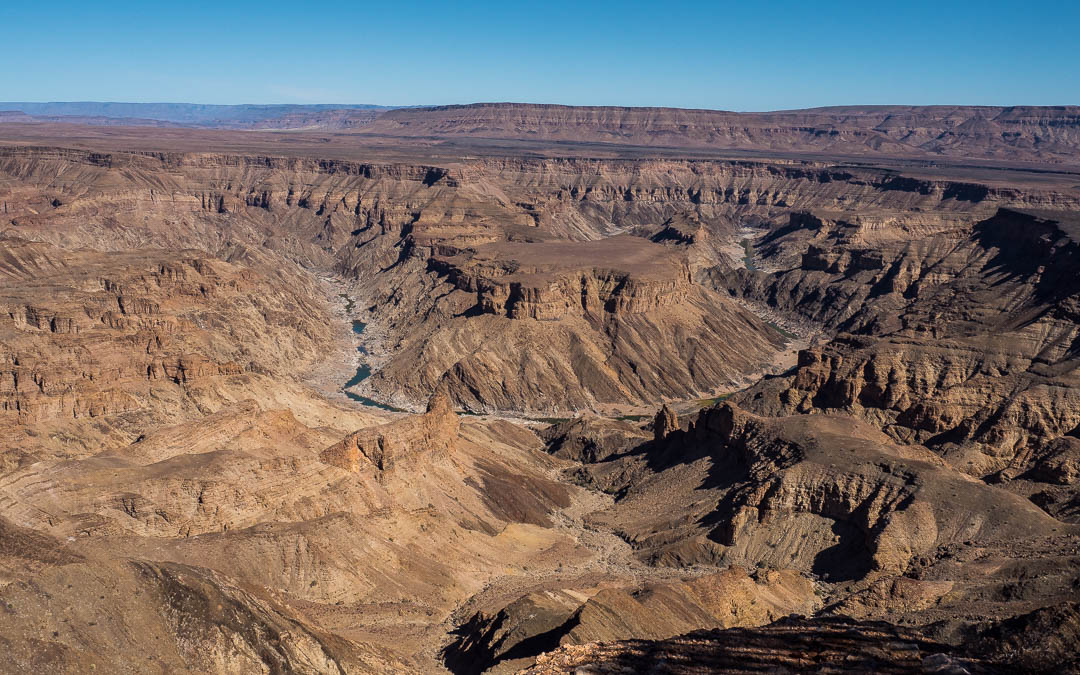
Fish River Canyon | Namibia | 2017With its breathtaking beauty the Fish River Canyon is one of Namibias prime tourist attractions. Behind only the Grand Canyon in Arizona, it is the second largest canyon in the world with a total length of about 100 miles (160 km), up to 17 miles (27 km) wide and in places almost 1800 feet (550 meters) deep. It was carved out by the Fish River about 600 Million years ago.
The Namibian night sky is spectacular. Last night at Gondwana Canyon Village I had a first try at shooting the stars. I took this image right next to the cottage we were staying in.
Camera was the Olympus OM-D E-M1 with the mZuiko 12mm F/2 wide angle prime. I put the camera on a tripod, set the 12 second self timer (to avoid camera shake) and dialed in a 60 second exposure time at F/3.2 and ISO 400. I manually focused the lens to infinity. These are good starting points for some trial and error. For composition (as it was pitch dark in the direction I was looking) I lit the rocks with a torch while positioning the camera on the tripod, then turned off the light while taking the image. The lighting on the rocks came from the small walkway lights in my back of Gondwana Canyon Village, so I did not need to manually paint the foreground with my torch.
In lightroom I increased the white point to bring out the details in the milky way, opened the shadow up a tad, then adjusted the grad curves until I was happy with the results.
At next opportunity I will try a reduced shutter speed (like 1/30 sec) to make the stars more crisp while turning up the ISO a bit.
The “Streets of Nuremberg” continue with the road trip through Namibia. After leaving the capital Windhoek, we drove around 500 kilometers down south. First stop in the South of Namibia was Keetmanshoop with its famous Quiver Tree Forest.
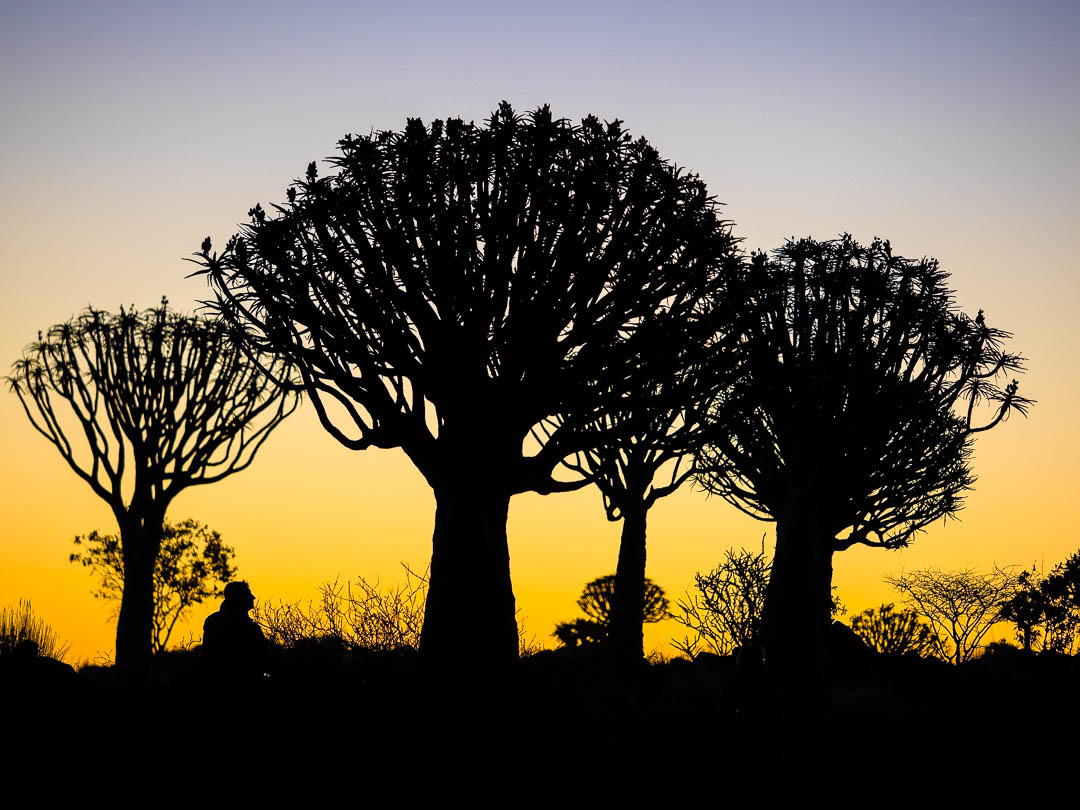
This unique piece of nature comprises of about 300 trees of “Aloe dichotoma”, more commonly known as “quiver tree” or kokerboom, because bushmen traditionally used its branches to make quivers. The tallest quiver trees are two to three centuries old.
Quiver Tree | Namibia | 2017
African Sunset | Namibia | 2017
We arrived at the Quiver Tree Forest in the late afternoon, it is spectacular in the light of the fading day and to photography the tree silhouettes in front of the golden evening sky.
Tomorrow we will head to Fish River Canyon, the second largest canyon in the world only behind Arizona’s Grand Canyon. Stay tuned for more of Namibia!








Recent Comments